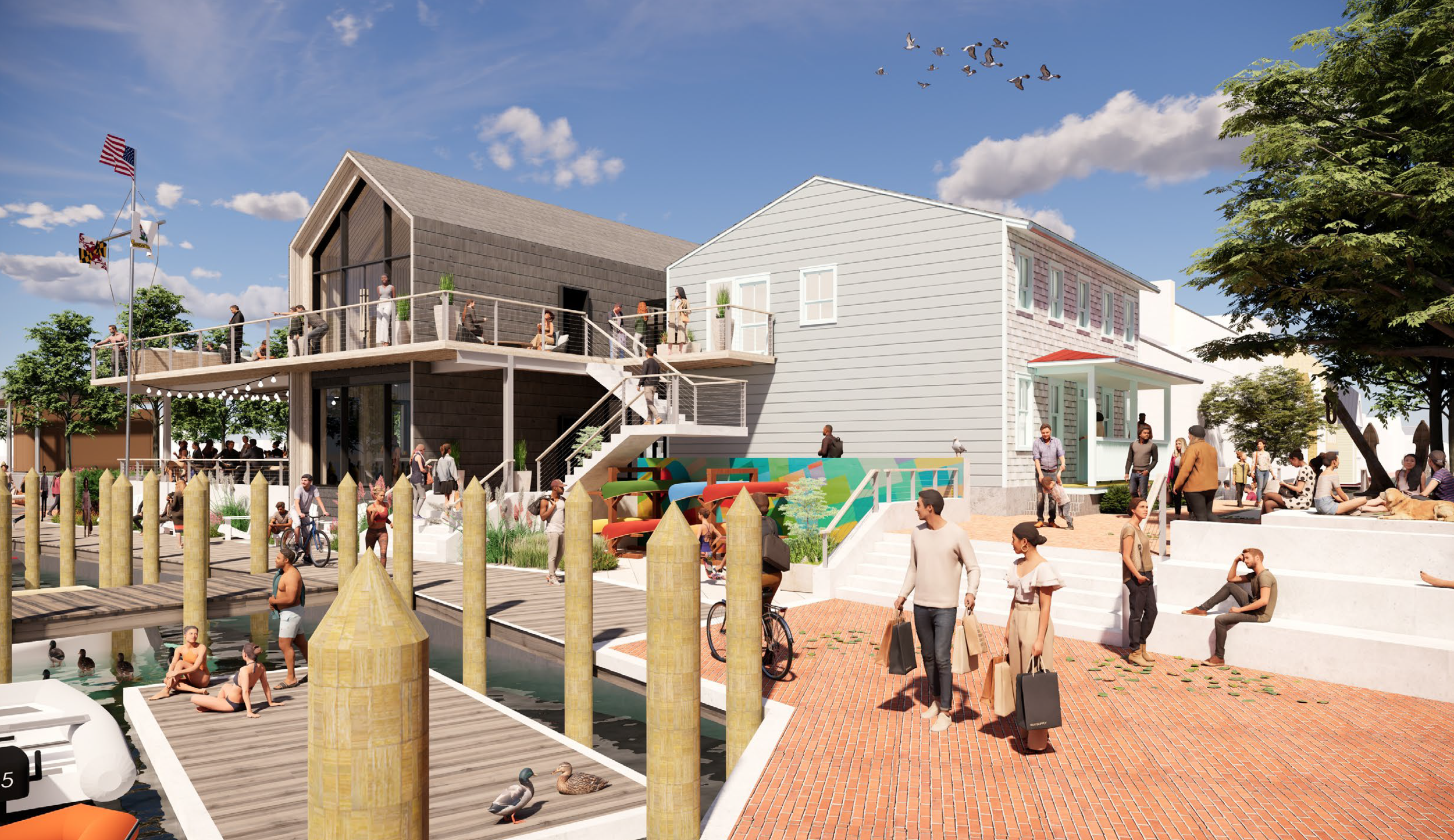
About the Project
For at least 100 years, downtown Annapolis has battled nuisance flooding. Prior to the 1980s, this happened every few years. Since the 1980s, flooding events have become both more frequent and more severe. In fact, of the top ten flooding events that have happened in the entire recorded history of Annapolis, more than half have taken place since the start of the new millennium.
In 2019, City leadership gathered 100 people to crowdsource a solution. They were sworn in as commissioners of the “City Dock Action Committee,” or CDAC. They met, discussed, and argued (just a little) through solutions, eventually reaching consensus and publishing their findings as the CDAC Report (LINK).
Since the publication of the CDAC recommendations, the City has undertaken a collaborative process to design and engineer a resiliency project while gaining community and governmental approvals.
As of 2025, the City of Annapolis, in partnership with state and federal agencies, is bringing a bold vision to life: one that protects downtown from the impacts of flooding while enhancing public access to the water, boosting economic opportunity in historic downtown, and providing green space for all.

City Dock Updates:
OCT 20, 2026
Progress Reel and Appellate Court of Maryland Affirms Approval of Maritime Welcome Center
On Monday, October 19, 2026, the Appellate Court of Maryland issued an opinion affirming the approval process for the Maritime Welcome Center (MWC) at Annapolis City Dock. The lawsuit against the City’s Historic Preservation Commission (HPC) was filed by Historic Annapolis after HPC approved the Maritime Welcome Center in April of 2025.
The Appellate Court opinion holds that HPC fully complied with local zoning laws, proper Commission procedure, and historic preservation design guidelines. Construction work at City Dock continues.
In a lower court ruling in September of 2025, the Circuit Court for Anne Arundel County upheld the HPC’s approval of the Maritime Welcome Center. This case represented an appeal by Historic Annapolis of that ruling.
Among the issues the court evaluated in the decision were whether the MWC design operates as an independent waterfront structure under existing City zoning definitions rather than an addition to the historic Burtis House. The Appellate Court decided that HPC decisions were supported by substantial evidence, including expert testimony on site design, setbacks, and historic compatibility.
OCT 1, 2026
The Old (New) Capt. Burtis House
In the 1880s, the area along Prince George’s Street was a bustling neighborhood of watermen and tradespeople who relied on the bounty of the Chesapeake Bay. Known as Hell Point (originally as Hill's Point), the neighborhood included homes in the area of King George Street, Randall Street, Prince George Street, and Holland Street.
In 1940s, the United States Naval Academy acquired properties through 12 separate land purchases and landfill projects along the Severn River. The Naval Academy went from a 10-acre campus in 1845 to its present size of 338 acres. The land acquisitions in the area of downtown eliminated most of the neighborhood of Hell Point.
Just outside the expanded Naval Academy footprint, at the end of Prince George Street, stands the sole surviving 19th-century waterman’s cottage on the Annapolis waterfront. The home was built in 1882. Known today as “Burtis House,” it was the one-time home of Captain William Burtis (shown at left) and his family.
During Capt. Burtis’s lifetime, he expanded the house from a duplex into a single-family home. He operated a boat rental, fishing, and touring business directly from the property (convenient at the water’s edge).
He was locally famous for having harpooned a 9.5-foot-long, 900 lb shark in waters off Prince George Street. The day after the shark was brought to shore, the story was front-page news (see sidebar).
The Burtis family owned and lived in the house continuously until 1971, when Captain Burtis’ descendants sold the property to the State of Maryland.
From 1971 until 2022, it stood at the water’s edge. During that era, the property was home to the Sailing Hall of Fame and the Maryland Department of Natural Resources. By 2019, both had departed and Burtis stood vacant.
SEPTEMBER 22, 2026
Engineering Resilience for Flooding and Runoff
For centuries, City Dock has stood as the maritime gateway to Annapolis. As the City’s long-time working harbor, its location at the water’s edge leaves the land adjacent to Ego Alley and Spa Creek vulnerable to two types of flooding: tidal inundation as water pushes up through the Chesapeake Bay, and stormwater runoff that enters the estuary from stormwater that flows over streets and off buildings.
Protecting City Dock and the surrounding community requires a solution that addresses both types of flooding. Upgrading the site while maintaining a good portion of the existing infrastructure has made the engineering challenges even greater. Instead of starting from scratch, the City Dock flood mitigation infrastructure is engineered to work in harmony with what already exists at the site, including the existing bulkhead system and some of the existing stormwater systems.
Let’s look at the two different solutions separately:
Tidal Flooding
During storms and extreme high tides, water pushes up through the Chesapeake Bay and into low-lying areas (like the top of Ego Alley) and stormwater outfalls (including the storm drains on Dock Street) creating flood conditions.
To combat tidal flooding, the defenses have to be built higher. Because City Dock isn’t a vacant lot, we couldn’t do what engineers might do on a cleared site (install utilities and foundations below the elevation of the old parking lot). But even though deep excavation was out of the question, there was still a way to engineer a solution where the existing systems remain functional.
JULY 29, 2026
City Dock Progress Report
As the City Dock Flood Mitigation Project moves forward, it is important to provide updates. The great news is that we are on schedule to reopen City Dock about a year from now. Crews are working as quickly as they can to get to the phase of the project we are all anxious to see: “completion.”
Throughout the more than six years of planning for the City Dock project, the downtown business community was consulted and informed of what the construction process would entail. Now that the project is well underway, we hear the frustration, which is an understandable part of any infrastructure rebuilding process.
The Mayor, City Council, City staff, and the teams at Whiting Turner care about the impacts on downtown merchants. That is why we are pushing the project forward with such intensity. It’s also why we added 165 additional parking spaces at the rebuilt Hillman Garage (about 500 feet from Market Space). It’s why Whiting Turner has brought in additional crews.
MARCH 7, 2026
FEMA Grant Comes Through
On Friday, Mayor Jared Littmann and the Annapolis City Council announced a major federal funding milestone for the City Dock Flood Mitigation and Resiliency Project. After years of coordination and partnership with the Maryland Department of Emergency Management (MDEM), the Federal Emergency Management Agency (FEMA) has signed off on a $35.5million Hazard Mitigation Grant to fund critical infrastructure to protect and redevelop the Annapolis City Dock.
The funding was announced during a Friday press conference:
https://www.youtube.com/watch?v=yvV28QCkqpU
The City of Annapolis team that worked on this grant, as well as securing both State and Local funds, included the Office of Emergency Management, the Department of Public Works, the Department of Planning and Zoning, and the Mayor’s Office. This project is urgently needed: in 2024 alone, the City recorded 120 flood events, double the previous record, highlighting the increase in flooding over recent decades, with the heart of downtown Annapolis bearing the brunt of direct losses.
Mayor Littmann has been clear that “City Dock is the heart of our downtown waterfront. Protecting our vibrant and historic community from flooding and associated costly damages will ensure that our small businesses, residents, and maritime and tourism industries thrive for generations to come.”
"Resilience is about infrastructure, but it's also about protecting our people. Maryland is leading through partnership, showing that we respond to challenges together with urgency and get ahead of them," said Gov. Wes Moore. "Securing this funding for Annapolis means protecting residents, strengthening small businesses, and preserving the maritime traditions in one of America's great cities."
In addition, the City extends its gratitude to our federal partners, including the federal congressional delegation of Sen. Chris Van Hollen, former Sen. Ben Cardin, Sen. Angela Alsobrooks, Rep. Sarah Elfreth, and former Rep. John Sarbanes. This success would also not have been possible without the ongoing commitment from our partners at the United States Naval Academy and Naval Support Activity Annapolis, and its Superintendent, Lt. Gen. Michael Borgschulte, FEMA, as well as Governor Moore and his administration.
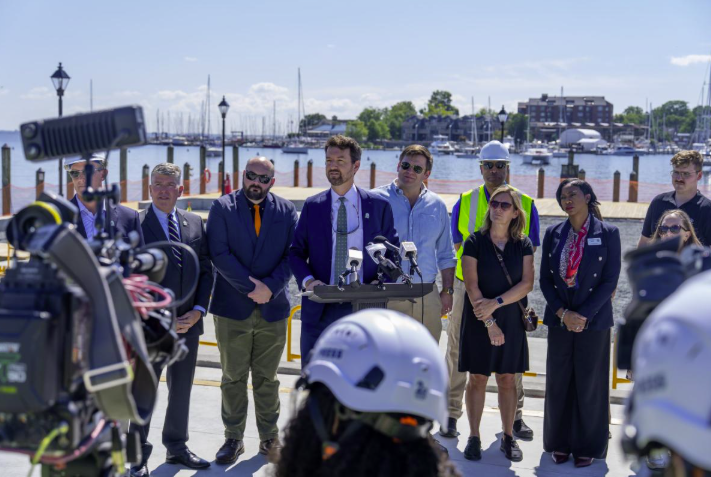
AUGUST 28, 2026
Construction Schedule Updates
Over the past week, the City of Annapolis has given multiple updates on the City Dock project. The good news started on Tuesday, when we held a press conference to announce that the City Dock project is proceeding on budget and ahead of schedule! Here is the current projected timeline:
December 2026: US Naval Academy expected to reopen Barry Gate, restoring foot traffic to Dock Street
March 2027: Ego Alley reopens to pedestrians and large blue dewatering tanks removed from the construction site
July 2027: Opening of City Dock Park and the Maritime Welcome Center
Summer 2027 to Spring 2028: Revised Phase Two plan that limits closures along Upper Dock Street, the top of Ego Alley, and on Compromise Street
We also reiterated that the project is on budget. Funding from FEMA, along with previously announced grant and bond allocations, ensures all necessary financing is in place to complete the project.

An elevated and resilient City Dock, designed to reduce the impacts of tidal and storm surge flood events.

A series of mechanical and floating flood barriers around the perimeter of Ego Alley.

A new, raised waterfront park with open lawn, native landscaping and shade.

Flexible and programmable public space for festivals, markets, and events.

Honoring and celebrating Annapolis’ maritime history and diverse cultural legacy.